By Don Ford, Entertainment Editor Originally published in the Brampton Guardian, Friday, May 12 1995
Give Diana Yampolsky a microphone, video camera and 10 hours, and she can transform average singers into quality performers.
Yampolsky runs the Royans School for the Musical Performing Arts (197 Queen St. E.) where she provides students with what she says is a one-of-a-kind teaching method that concentrates on the performer as a whole and not just their voice.
“The approach I take is absolutely mental,” the Russian native explains, adding that, “the voice is really just a printout of what’s inside a person.”
The voice, Yampolsky believes, is like one big muscle that relies heavily on other parts of the body including the face and abdominal region for assistance during its performance.
From singers hoping to become professional recording artists to people who simply want to improve their karaoke skills, Yampolsky offers people an opportunity to come in for an individualized introductory assessment to determine how much potential they have and get a taste of what she has to offer.
What Yampolsky has to offer is a background in music that includes eight years of training at Leningrad’s School of Music followed by four years of music teachers’ college where she earned Bachelor of Music Education degrees in voice and piano.
In 1980, she came to Canada with the intention of singing and teaching. She soon realized that the vocal exercises she was doing before singing only helped to warm up her voice, instead of helping improve any technical problems that might exist.
Over time, Yampolsky developed her own vocal technique that relies more on facial and abdominal muscle use and result in less strain on the vocal cords.
How much natural talent a student has usually dictates how far they can go with the training. Yampolsky says her program’s technical component will provide 75 per cent of any singer’s performance. Singers who can supply an additional 15 to 20 per cent natural ability, should be able to perform at a professional calibre.
According to its inventor, the method works for all types of singers from classical to heavy metal.
“It’s not just singing lessons,” the teacher insists, noting that her method is not being taught by any other Toronto-area school. For those who choose to enrol in her accelerated program, Yampolsky even offers a money back guarantee to back up her bold claim of 100 per cent success.
Videotape evidence of the program’s achievements can be found along a wall of the energetic vocal trainer’s studio. Yampolsky always videotapes the before and after performances of her clients as living testimonials to the success of her method.
In addition to the audio/visual evidence, Yampolsky can boast actual examples of former students who’ve gone on to reach their ultimate goal of singing in public, in some cases professionally. Some former pupils of the Royans school have included Mike Maida of Sony recording group Our Lady Peace, George Michael impersonator Mark McAllister and Sabina Petermann, a singer invited to perform the national anthem at Maple Leaf Gardens before a Toronto Maple Leaf game.
In addition to improving the voices of singers over a short period of time, Yampolsky offers one-on-one sessions to correct speech problems.
– Written by Christina Grant, Canadian Music Educator magazine
As a vocalist, I have often been overwhelmed by the many interconnecting elements involved in a single performance. What I appreciate most about this book was that it provides an overview of many key issues relevant for the emerging vocalist. It is especially unique in its attempt to encompass the vocal music demands of popular music.
Diana Yampolsky sets out to dispel several myths about vocal technique and to make assertions about appropriate technique based on her years of experience. The simple explanation about the physiological reasons for her assertions are helpful; as a music educator, and as a researcher, I would have appreciated references to other reading that also support her position.
The author provides a quick overview of the issues surrounding physical and emotional well-being, and the role these play in being able to successfully connect with an audience. A detailed and specific account of these strategies and their applications would be of great interest to me both as an educator, and as a performer. I found the section on herbal alternatives for vocal care particularly informative. Several herbal products are recommended for specific concerns.
The author speaks from her personal experience, sharing the story of her personal journey as it has influenced her current practice. The narrative style is easy to follow and provides an introductory glance at issues of particular relevance to singers establishing themselves in the various popular music traditions.
– The reviewer can be contacted at: kidjazz@yahoo.com.
“Your software has a virus,” says Diana Yampolsky as I lower from tiptoe to flat foot and catch my breath after another tongue-tied run-through of do re me fa so la ti do.
“There is hope,” she continues, though I’m doubtful. I’m learning to sing. Or hope to anyway.
For years I’ve kept my mouth shut, even in the shower.
And except for car radio sing-a-longs, I haven’t belted a song in public since I was in The Wizard of Oz in Grade 6. Belting, actually, overstates my marginal contribution in the chorus.
I refrain from singing as a public courtesy. That is, until I read an ad in Eye weekly. “Beginner to professional singer in 10 hours. Guaranteed!”
At first, I dismiss it.
Another wanderlust-appealing gimmick, the kind of instant offers (learn to be a square dancer/fire-eater/car racer) found on matchbook covers. Except this ad has a client list with a familiar name: Raine Maida. He’s the good-looking, multi-million-selling voice of Our Lady Peace, the Toronto rock quartet that rivals the Tragically Hip as Canada’s favourite act.
So with curiosity and scepticism I head to The Royans School (For the Musical Performing Arts) located in a squat, two-storey strip plaza in Willowdale. Neighbours include a cleaners, driving school and a restaurant that’s closed with a sign in the window promising Middle Eastern delicacies.
Yampolsky is a robust, 41-year-old Russian-born vocal coach whose soaring alto and powerhouse personality are packed into a large frame. The school she founded in 1984 is a two-story room studio with hardwood floors and walls decorated with typed testimonials, photographs of ex-students and a homemade Elvis clock – a gift from a former student-turned Elvis impersonator.
There, the former Leningrad choir director teaches about 25 lessons a week to a range of wannabes from those with no musical training to those with considerable experience behind a microphone – more than 15, 000 of them since coming to Toronto from Russia in 1980, she estimates. “A lot come to me because of word of mouth, a lot (because) of advertising and definitely by results,”she says.
Reasons vary. Some are interested in wooing the opposite sex. Others want to polish their pipes so they can sing at funerals and weddings and “some of them feel that they need a release, that there’s a lot inside of them and they don’t know how to express it so their very first intuitive thought would be, ‘If I learn how to sing I would be able to do this through music.’ “
In 1993, before his fledgling band signed a record deal with Sony Music Canada, Maida came for eight 75-minute sessions. Then he went away and became a star. Maida’s father later enrolled to brush up on his public speaking skills, another facet of Yampolsky’s business.
One of two dozen or so vocal coaches listed in the Yellow Pages, Yampolsky can document her work. She pops in a videotape of one unremarkable crooner, hands stuck deep in his pockets, mangling The Doors “Light My Fire.” Then the same singer, after instruction, singing in tune.
“It takes a very balanced person, not flying on the handle of emotions,” she says.
Her method, she explains, is a holistic approach recognizing that the voice is a reflection of the inner self, an imprint of your personality. It’s a revolutionary approach, she contends, one that works on the brain, not the vocal chords.
A singer’s ability is 25 percent natural talent, she believes, and 75 percent technical training. Good news for me. Further, someone with natural ability can still produce horrific sounds. “A beautiful body doesn’t make you a good dancer.”
Yampolsky, who knows I’m writing an article for The Star, says she’ll begin by assessing my instrument.”
First, the most obvious flaw. “You’re short. Obviously, a larger person like me will be able to produce a fuller sound.” A first-time, 75-minute meeting costs $65. Ten hours of instruction costs $890.
She rises, turns to a keyboard, tells me to stand, and presses her finger firmly on the middle C key. “One,” she sings with full bodied resonance. “One,” I repeat, timidly.
Pausing, she follows with a three-note scale. “Wait till I’m finished,” she instructs. Inexplicably, I sing along. “Wait till I’m done,” she repeats.
We do this a few more times and she renders a verdict. “It’s unlikely to think that you might become professional,” she says. So much for my dreams of a Celine Dion duet at the Grammys. I remind her of her ad promising she can transform anyone into a singing professional in 10 hours. “Good point,” she replies. “That’s why I qualify who is a beginner. You’re a pre-beginner.” But not tone deaf, apparently.
We proceed to the next phase. Yampolsky nudges another video cassette into the VCR. An important component of her method is capturing students on camera. “Students quickly HEAR, FEEL and SEE the results,” reads her promotional material. Those results, incidentally, become the property of Royans once students sign a legally drafted “letter of agreement.”
For my audition, I reach for Roy Orbison. “He’s a man,” she says, taking the song book and cassette away.
I point to the not-even-close Alanis Morrissette-lookalike on one of her tape covers. Yampolsky takes out a cassette and hands me a lyric book. I decide on “Hand in My Pocket,” Morrissette’s smash hit in 1995, thinking that it’s not one of her most vocally adventurous numbers.
Yampolsky presides in her chair by a camera, TV monitor and tape deck, her version of Japanese karaoke. (Karaoke means “empty tapes” which contain the band tracks for songs, without the singers’ voices. Yampolsky’s version allows her to lift or submerge Morrissette’s wailing at will.)
She records the date, time and my name before a familiar guitar riff fills the room. “I’m short but I’m happy, I’m poor but I’m kind,” I sing – though it sounds a lot like speaking – while reading the lyric sheet.
She replays the videotape. No savage beasts will be soothed today. I hear a weak voice and off-key notes.
Singers say it’s a way to express themselves, a way of telling things you don’t find easy to say. E-mail works for me and so far I see no reason for that to change.
“I have no idea where you’re coming from,” says Yampolsky. While her English isn’t always precise, Yampolsky’s vocabulary is rich with vivid analogies. She variously invokes images of skewering shish-kebobs, Steven Seagal, the Titanic, jet takeoffs, skaters and coffeemakers. Visualization is key, she says, when learning to sing.
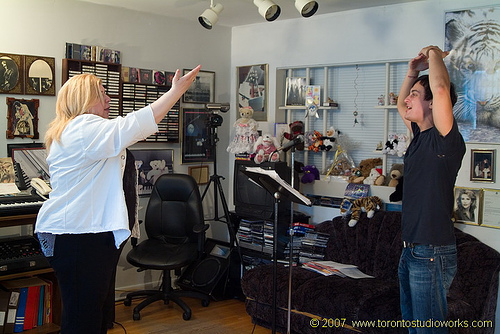
When we move to vocal exercises, she demonstrates the routine singing position which relates to body alignment, the key to Yampolsky’s technique. She stands straight, holds her stomach in and, simultaneously, rises to her toes and raises her arms above her head. From there she says to “bite” down on the number one and continue counting through to five. After several times, I progress to sound combinations: de di doh, then ma me mi mo followed by “ah oo eh oh ee” on tiptoe, throwing my arms in the air.
It’s a frustrating, unsettling and relentless exercise. It should be simple yet I stumble, mixing da with de, ma with me. I’m not “attacking” the first syllable or using my arms for “lift off.” Yampolsky shakes her head. “You’re not decorating a Christmas tree.”
She doesn’t mention that my “doh” sounds like Homer Simpson.
Throughout the world, vocal coaches counsel their students to drop their jaws. Not Yampolsky. “I’m the only one who says otherwise, she says. I close mine.
We cap these not-so-nifty tongue-twisters with a verse about lemon trees looking real pretty because the flower is very sweet, emphasizing each syllable. That, she concludes, is the skeleton of every song. “From here to incorporate singing is nothing.”
Our next few visits are compressed – I’m only doing five hours instead of the recommended 10. We repeat many of the same exercises with added technical emphasis. Using facial and abdominal muscles with proper posture are key elements. We work on stamina and pitch.
One morning, I run into trouble. “Your words are sitting at the back of your throat,” Yampolsky says. “It’s a turn. It’s like driving on the DVP (Don Valley Parkway) and you know you have to adjust the wheel or you’ll go off the road.”
Yampolsky offers criticism that’s neither destructive or negative. She went ballistic when one student announced she “hated” her voice. “That is a prohibited word.”
At the end, another taping. “Everything is fine, fine, fine,” I sing.
As we watch, minutes later, Yampolsky smiles. “You got all the high ones,” she says. “This is amazing. It’s not 100 percent but it’s exactly where we should be after five hours.”
We watch again. I see a boost in confidence and hear clearer enunciation. My voice is stronger, my inflection more precise but my interpretive powers are limited.
I’m encouraged but not enough to subject myself to endless da de di’s and lemon flowers.
Yampolsky asks me what I think. I parrot her reaction and agree I’ve improved and notice the tape is still rolling. Another videotaped testimonial.
What the tape doesn’t capture is what I’ve learned about the process. Yampolsky asserts years of hard work aren’t required to become a moderately good singer.
Perhaps.
But drive, focus, persistence and patience are all part of learning to “free the sound” Yampolsky maintains is locked inside us all.
Interview with Diana Yampolsky published in Exclaim Magazine
A graduate of the Lenigrad Music Teacher’s College, Diana Yampolsky is a renowned specialist in the human voice. She came to Canada in 1980, and in 1984 founded the Toronto-based Royans School for the Musical Performing Arts where she teaches her Vocal Science Immersion Program. She is also a leading voice repair specialist and writer.
What are the principles of your method, Vocal Science?
What I am doing is basically restructuring the voice off of the vocal box and into a different set of muscles – we’re talking about the facial muscles where the four main vocal chambers are located. That’s where the sound will flow in one direction and flow as a projection outward, provided that those facial muscles work in full conjunction with the abdominal muscles.
So this has nothing to do with Bel Canto?
Not at all. In my opinion you cannot teach opera. You’re either born with a vocal box size XXX or you’re not. Because what conventional vocal coaching is suggesting is that if you drop your jaw down to your knee and magic will happen because you have enlarged the capacity of your vocal chords. Everyone is born with small, medium, large, extra large vocal chords, if you drop your jaw and stick your stomach out like conventional vocal coaching is suggesting, you’re right away going to ruin your voice. [My technique] is completely the opposite of what the whole world is saying. And guess what? It works.
In terms of training and caring for their voices, what are some of the things that you think singers should know?
We’re talking about a whole mechanism, which allows our voice to work in its full capacity but only if you comply with its components. The components are: support from the lower abdomen, which is responsible for the height of the sound; upper diaphragm, which is responsible for the width of the sound; taking into consideration the central line of your body, nose to belly button; and then placing every syllable on top, over, above the previous syllable in a circle direction on the central line of your body. What [conventional coaches] suggest is just to sing within your anatomy. But as I say to all of my artists, nobody is interested in your anatomy; we all have the same. What we are interested in is in your voice and in your spirit, which has to be discovered, uncovered, and flown to its own destination, by design. I believe in doing warms-ups, but not goo-goo-ga-ga-miao-miao scales, which everybody is doing, which have nothing to do with the price of rice in Afghanistan.
Do you think that rock singers, many of whom don’t have any training, are doing something dangerous with all the yelling?
Yes, absolutely. That is why they all come here for voice repair. It was very interesting to watch my client Lukas Rossi [winner of the TV reality series Rock Star: Supernova]. On every show, someone was saying, “Look at that” some kind of unknown vocal technique!? And then the vocal coach on the show – we saw this on the web – suggested to Lukas to drop his jaw and he just looked very puzzled and walked away. But after that, Jason Newsted said to him “Lukas, drop your jaw!” and Lukas finally gave in and it sounded so terrible it was beyond human understanding. He had been doing the rock star style that I was teaching him, using the facial muscles working in conjunction with the abdominals, and he all of sudden dropped his jaw to knee and it sounded off key, off colour, off tune! But the good news is they will all come eventually to me for voice repair.
In last month’s column, entitled ‘Vocal Inadequacy – In Need of Non-Surgical Voice Extension?’, I explained how singers can compensate for short and/or thin vocal cords by strengthening their lower abdominal and upper diaphragm muscles and working on their facial cavities in order to make them larger and deeper. This month I would like to talk about two common “ailments” that have infected quite a few of the singers that I have come into contact with over the years: “Vocal Constipation” and “Vocal Diarrhea”. In the following paragraphs I will describe the symptoms (so you can decide if you might be so afflicted?) and then outline the cures.
The more common of the two is “Vocal Constipation”; the majority of singers actually suffer from this “nasty disease” to some extreme. The symptoms of this “disease” are clearly visible and easily detected: red stressed neck, bulging veins in the forehead and a very ugly sound coming out of their wrongly positioned body. Doesn’t sound very attractive, does it? (You may even have seen these symptoms if you ever had your picture taken during a performance when you were trying to hit a high note; these symptoms are always present when you are trying to “force” out the sound rather than let it come out naturally.) Aesthetics aside, this is actually a very serious issue. While pumping the veins in this manner, the singer is depriving his brain of oxygen and cutting off the circulation, which can actually lead, in extreme cases, to a stroke or heart attack. There are actually known precedents of singers who literally dropped dead on stage!
Regardless of whether this “constipation” is causing discomfort for you or your audience, you can be assured that a cure is available. Firstly, be sure that your body is completely relaxed and at ease, paying special attention to the condition your neck is in. (If you feel that it is very strained, you need to release it from tension as soon as possible.) Secondly, pay close attention to the positioning of your shoulders. (Vocal “Constipators” always have their shoulders in an uplifted position that contributes to attacking the sound from the bottom of their throat, which leads to additional strain on their vocal chords and their vocal box in its entirety.) In my book, Vocal Science – Flight to the Universe, there is a picture of a space shuttle (p.8) which describes the separation of the three components of the space shuttle when it is ready to take off. The lower part is the launching pad, which is equivalent to your physical body from the waist down. You have to stand solid on the ground and be very centered, but not tensed. Then you take a breath, which also involves three components of that wholesome mechanism; the lower abdomen, which is responsible for the support of the height of the sound (make sure you suck your air in, not out, as you will put the “brakes” on your movement), upper diaphragm, which is responsible for the width and body of the sound, and mouth breath, on top of which the sound will be flying on a parallel track in full synchronicity with it. They will allow your voice to work in the fullest capacity possible. This is comparable to the hundred tons of nuclear power, which propels the rocket upwards and gives it a driving force. Please note that the rocket flies above the flame and, hopefully, not with it as it happened in 1986, when the Challenger blew up due to the separation failure upon takeoff. If you follow these principles, your “flight to the universe” will be a safe and pleasant one for you and your audience.
The other “disease”, “Vocal Diarrhea”, is less common, but as its metaphorical namesake suggests, is quite “messy”. Like “Vocal Constipation” it is also easily detected. Usually, the person with a weak vocal anatomy and a lack of knowledge of how to properly use their voice is most likely to be “afflicted”. Recently, one of my new clients came to me with a dance hip-hop track that was pretty well written and produced. Unfortunately, her vocals were “dripping” all over the music and did not do justice to the song. (Initially, I did not even realize how good the song was because the vocals were so weak; sometimes people forget that the singer makes the song and that the singer is responsible for properly delivering the main message of the song. In my opinion, all performers should remember the following equation: good music + good singing + good production = the total performance. The puzzle will not be complete if one of these components fails.) I also would like to mention that this particular vocalist was a slim female of above average height. Therefore, it was quite natural that her vocal cords were pretty long but they were thin in diameter. The result of this was that she possessed a high, light soprano voice that was not really suitable for the R’N B Hip Hop that she was attempting to sing. As I already mentioned, I did not have a problem with the length of her vocal cords; the problem was the width. In last month’s column, I explained how you could work to extend the length of the vocal chords. In this issue, I will talk about how to widen, not the vocal chords (which is physically impossible), but the sound they produce. The width of the sound very much so depends on the upper diaphragm, i.e. your rib cage. It works on a principle similar to the way in which an accordion works: the air is pulled in and pushed out as much as the musical phrase is demanding. In the instance of singing, the upper diaphragm carries the similar function. The singer has to assess the length-width of the upcoming musical phrase and open up the upper diaphragm accordingly. The body of the sound is very much dependent on the flexibility of the upper diaphragm and, in the majority of cases, its proper use will compensate for inadequacy of the width of the vocal cords. By the way, the length of the vocal chords can be “extended” through the proper use of the lower abdomen; the more you can tuck the tummy in, the better lift the sound will have off of the vocal chords and the higher the arc will be and the longer the trajectory of the sound will be. The inertia will complete the flight.
To conclude, both of these “illnesses” can be cured with the proper “medical assistance” of a good vocal “doctor”. Look for more prescribed medicines in the coming months and visit my website at www.vocalscience.com for more vocal prosperity tips.
In this article, I would like to talk about an interesting observation that I have made over my 26 years as a vocal coach; not too many people realize that there are several aspects that have to be addressed with regards to singing in general. First of all, when we talk about singing we are talking about two separate, but very much related elements: physical sound and emotional style. Physical sound is what is achieved by proper utilization of the technical aspects of singing, i.e. breathing (support), structure, placement and projection. Emotional style is essentially how the singer relates to the song and anticipates and complements the style of music, i.e. rock, alternative, country, R & B, dance etc. A common view is that while the technical aspects of singing can be learned through instruction and repetition, style is only developed naturally over time. There is definitely some truth to this statement; some people just naturally have it within them. As a Vocal Coach/Consultant, I strongly believe in the advantages of instruction in the technical aspects of singing. However, I also believe that it is a mistake to completely separate style from technique and I believe that style can be taught in a similar way that a student can be educated in how to stay in tune, project their voice, etc.
As an analogy, you can find quite a few parallels between singing and figure skating. If you are familiar with figure skating you will know that the skaters are always judged by two criteria: Technical Merit and Artistic Merit. Again, in this instance, it appears that those components are separate due to the fact that they are judged separately (however, in relation with each other). As for singing, upon closer examination, you will realize that the two are very much intertwined. Afterall, a figure skater that is falling on their rear end is most definitely not going to get high technical marks; therefore, the marks for artistic impression will not matter. Similarly, a figure skater that can land all their jumps perfectly, but skates to the music in a robotic fashion, is not going to win any medals either.
As with figure skating, the technical component of singing is the platform on which the artistic expression stands. As mentioned earlier, the main technical components of singing are: support, structure, placement and projection.
Abdominal support is responsible for the height of the sound.
Upper diaphragm support is responsible for the width (body) of the sound.
Structure – is the structure of the syllables which should be stackable (one on top of each other) and placed on the central line of the body.
Placement is the domain of the four main vocal chambers, which ultimately are the same as your sinus cavities.
An “aimed” projection is the natural outcome of the previous three componants. (I talk in more detail about these technical components of singing in my book, Vocal Science – Flight to the Universe.)
Once you’ve achieved mastery of these four components, you have achieved technical control of the physical sound. The next step is to ‘dress it up’ so that it is original, emotional, exciting and affecting. This is akin to a figure skater whose costume and movements reflect the music that is accompanying the performance. With regards to singing, the physical sound produced must correspond with the style of music and the musical instruments used in its production. Recently, I saw a popular pop singer deliver what was clearly an R & B song with a classical sounding voice. It didn’t sound very good because the sound of the voice was so alien to the style of music being played by the band. She actually had a strong sounding voice and, thus, would have received high marks for technical merit if there had been official judges; but also definitely a failing grade for her artistic interpretation. In this instance, the TOTAL PERFORMANCE was not achieved.
I do believe that style can be taught. In fact, many people approach me to coach them specifically because they want to sing a particular style of music. One of my recently signed clients, a dance/R&B singer, had a recording session booked and asked me to come along for assistance. When I arrived at the studio, the session was already underway and I quickly realized that the song they were recording was not one that we had previously worked on. Moreover, this song was very demanding because it required a combination of three distinct styles: pop, dance and R&B. The song required that the singer sometimes had to change between styles as frequently as every second line. The producers were high caliber and definitely knew what they wanted, but were having trouble transferring their instructions on how to do it to the singer. She also knew what they wanted but did not exactly know how to achieve it. This is where I stepped in and was able to provide assistance. By quickly instructing my student how she could attain the requested stylistic elements, the song was successfully recorded in much less time than even the producers anticipated.
The majority of students that come to my school for instruction have a definite idea about the style of singer they want to be, but they don’t always know how to achieve it. From the very beginning of instruction, I always teach them the obvious, such as how to stay in key and project their voice, but also work with them on the stylistic elements of the songs they are singing. This is often done by breaking the songs down to individual lines and practicing the ways in which each syllable should be sung depending on the style of music. For example, if you are singing an alternative rock song you should be attempting it in a voice that is a little more raspy and somewhat nasal and less smooth sounding and with less or no vibrato. Please note that the rasp should be achieved without straining your vocal chords and is done by correctly coordinating the use of your facial and abdominal muscles. Quite a few of my students sought coaching from me solely because they wanted to achieve this raspy type of voice without damaging their voice permanently. This is one example of how the artistic style should be based on the foundation of flawless vocal technique.
Some tips on how to approach various other styles of music are as follows:
R & B: sing with a very wide smile. This will open up your resonator (natural amplifier within your facial muscles) and place your syllables as tightly as possible using your cheekbone muscles. This will prevent any vibrato in the voice.
Pop: the pop style is essentially the same as R & B but with a much lighter application. More laid back and in a sort of “boyish” or “girlish” style.
Classical: is definitely a more vertical application – not rounded like in R & B or Pop. The use of proper vibrato is an essential component of this style.
Country: is a mix of classical, pop and R & B. You could often hear a slight crying feel and a minor nasal application. Quite a few country singers use a light, breathy sound, which is also often used in pop singing.
Gospel: uses a classical application, but lately gospel is being associated with the R & B style. I guess it is really a combination of the two.
Hard Rock: uses a heavy-duty application of the classical style. Often using lots of vibrato will help to distinguish the singer from the loud guitars and drums and enable him to “cut through”.
In all of the above cases, the singer needs to have a strong technical foundation to their singing. Style is achieved by varying and applying the technical elements in different ways.
You can find out more about how to become a better and more professional singer, by reading some of the other articles available in the Publications Sesion of our site.
Vocal Inadequacy – In Need of Non-Surgical Voice Extension?
Written by Diana Yampolsky
SIZE MATTERS! Regardless of what anybody says, IT DOES. What am I talking about you may ask? I am talking about the voice and the sound it produces. As I have already mentioned before in previous columns, every human being is born with vocal cords of a certain length and width, as well as an individual facial structure. These two components play a crucial role in determining the strength and quality of sound your voice manufactures when singing.
The SIZE of the vocal cords usually corresponds with the physical size of the person. (This is generally true but there can be exceptions.) With this in mind, it makes sense that a short petite woman would have short, thin vocal cords, which will assign to her a high soprano voice. While a natural soprano voice lends itself very well to classical singing, it does not suit styles such as R’n B, Rock or Dance, which require a much more solid bass foundation and much less vibrato. Soprano voices tend to naturally produce excessive vibrato, which again is very useful and pretty for classical singing, but can be a hindrance for other styles. Is there hope that soprano voices can sing styles other than classical? Yes, but it requires hard work from both the vocal student and an experienced voice educator.
Sound is determined by the quality of the instrument producing it. For example, let’s compare two pianos. The first one is made of high quality wood and has steel strings. The hammers are also made from wood. The sound it produces is full and juicy and can even sometimes make an amateur player sound more accomplished The second piano is made out of 2X4 plywood. It’s strings and hammers are made out of plastic. Not suprisingly, it sounds thin and dry and can have the reverse effect of making an accomplished player sound inadequate. The same applies to the anatomical and physiological structure that makes up your instrument and the size and quality of which will determine the level of your vocal performance.
Does this mean that if you were born with short, thin vocal cords that you are cursed with a thin and unpleasant sounding singing voice? The answer is not necessarily. To a certain degree, the vocal cords can be stretched in length and strengthened in terms of power. Just as a body builder is, through exercise, diet and stretching, able to increase the size of his muscles, so too can singers. I have developed a set of exercises that work to lengthen and strengthen the vocal cords, as well as develop deeper facial cavities, which are so important with regards to producing a strong-sounding voice. (Going “under the knife” is not required!)
The majority of students who come to our school for vocal instruction usually arrive with non-existent or incorrect vocal technique. In one of my previous articles, entitled Vocal Impotence – In Need of Vocal Viagra?, I defined how to correct these technical imperfections. But over the years, there have been many students for whom this was not enough. Yes, after “taking Vocal Viagra” the sound they produced was more “upstanding” and even “erected” but still short in length. Due to the natural shortness of their vocal cords, they did not have enough length to curve the sound into the facial cavities, which prevented the sound from resonating and achieving the secure aimed delivery. For these students, I needed to artificially lengthen the vocal cords and strengthen their lower abdominal and upper diaphragm muscles, as well as working on the facial cavities themselves in order to make them bigger and deeper. This is comparable to a gymnast who, over time, is able to increase his flexibility until he can comfortably perform the splits. He needs to be careful and well coached in order to avoid injury. Just as he gets to his desired place on almost an inch by inch basis, I have to bring my students along relatively slowly when developing a naturally undeveloped instrument. One exercise I use to develop facial cavities and strengthen the vocal cords is what I call the “Biting Exercise”. It involves only the upper jaw and upper facial muscles and completely eliminates the lower jaw and vocal box itself, which releases and relaxes the vocal anatomy. The result is that the sound bounces off the upper palate in a curved position, which gradually increases the resonation and the body of the sound. This is one of many exercises that definitely work to achieve the desired result.
In a future article, I will talk about a couple unfortunate ailments that commonly infect singers: Vocal Constipation and Vocal Diarrhea. Look for the cures in the upcoming months.
Vocal Narcissism – Me, Myself and I? and MY VOICE!
Written by Diana Yampolsky
Let me tell you, my reader, that music is often called the world’s greatest communication tool. An effective piece of music crosses national boundaries, and a good song transcends any language barriers. With that said, a common problem that I have found which afflicts many aspiring singers is that because they do not realize that singing is a great vehicle for communication – ideas, emotions, lust, pain, frustrations, love, etc. Through singing, you can communicate those emotions more efficiently and also, more personally than with any other art form – be it film, writing or dance.
But, evidently, not everybody is able to effectively communicate a story through the musical form.
Some of the artists, unfortunately, appear truly self-absorbed, self-centred and purely egoistic, to even being able to share themselves with the audience.
Needless to say, that they are primarily thinking only about themselves, their appearance and their voice.
That’s what I call “Vocal Narcissism.”
For those who are not familiar with the term ‘narcissism’, I would like to explain its meaning. It actually comes from a Greek myth; Narcissus was a beautiful youth who refused the love of a nymph named Echo. In punishment, the goddess Aphrodite condemned him to fall in love with his own image. Forced to gaze constantly at his reflection in a clear pool, he dwindled away and then died.
Quite a few modern-day “Narcissus” have passed through my studio throughout almost 4 decades that I have been teaching. Those types of students have been amongst the most difficult pupils in terms of reciprocating my, however, very unique vocal technique. They have been so self-absorbed with the sound of their own voice, that they actually forgot the need to communicate their message to the audience (or even to me, for that matter).
Not too long ago, one of the major record companies sent me a student who had a lot of natural singing talent that needed refining. It was clear from the moment he opened his mouth that he had a truly beautiful voice and it was also obvious that he had absolutely no idea how to use it. (Although the above-described fact was obvious to me he, himself, was completely oblivious to it!)
In many ways, his singing was like a form of vocal self-satisfaction; he was satisfying himself, but not his audience (in this instance I was his audience) and it was clear that he didn’t even care who was in front of him.
The egoistic approach is the worst approach to singing because it separates the singer from the audience rather than bringing the two together. You could actually hear the conceit and arrogance in his singing, not to mention, that the lyrics of his songs sounded insincere and inauthentic.
In previous articles and in my first book, Vocal Science – Flight to the Universe, I have always stressed that the best singers naturally are willing to give and share part of themselves with the listeners. This student was the exact opposite; he was only concerned with his own needs and not with what the audience wanted or needed.
The reason that he was difficult to teach was not that he was unintelligent or untalented. He (as I mentioned before) was actually very smart and musically gifted. Instead, the same conceit and self-absorption that prevented him from sharing himself with the audience, also prevented him from more easily receiving what I had to offer. However, with my extensive experience (and, over many years, having witnessed many other “vocal narcissists”) I was able to get through to him and teach him everything I had to offer. Needless to say, it was a very exhausting experience and, nonetheless, it took a lot out of me.
That was about 20/30 years ago.
Nowadays, it has actually become much worse.
Some students/clients stand in front of me like they have been turned to stone (by Medusa).
I’ve always been communicating quite a bit with my students, and even (when was needed) advising them on other aspects of life (outside of but related to singing).
I’ve noticed that the communication between my students/clients is lately ceasing exponentially.
They stand in front of me like stone monuments, whereas, in comparison, the people in a coma have actually more vital signs than some of my clients possess.
How in the world are they trying to become artists?
Beats me… and, moreover, never ceases to amaze me!
They do not understand my jokes and my humour in general, or even if they do, they do not react to any of it like people always did before.
Some of them appear almost unconscious and somewhat frozen…?
Whatever happened to humanity?
Is that a pandemic fault? Maybe yes, maybe no… In all honesty, I did notice the above-described behaviour of certain people even sometime before.
I have to say that almost 4 decades later, it is still quite shocking to me.
I am, however, hoping for the best, and for the best is yet to come for all of us!
If by any chance, it doesn’t, then at that moment we will know that the world is truly ending (Armageddon).
Vocal Narcissism is very sad if it remains “untreated,” because it is much like a beautiful instrument that is being played by someone who doesn’t know how to do it justice. I have a wonderful, unique piano in my studio that I brought with me from Russia over 40 years ago. By itself, it is only a piece of furniture. It takes a really good player to do it justice – the player who is able to extract the maximum capacity of this instrument. As I always say, it takes two – the instrument and the player to achieve what I call ‘A total performance’. A naturally beautiful voice is very much a gift from God, and it is indeed an ‘instrument’ for communication through vocal performance.
“Vocal Narcissism”, most of the time, results in singing that will leave the audience unsatisfied despite the fact that the singer might have had a beautiful voice, but, on the other hand, happened to be not an adequate ‘player’ of his given to him ‘instrument’. All of that is because there is only one-way communication happening and only one-way satisfaction taking place – clearly “screaming” out “Me, Myself and I… and… MY VOICE!”.
How sad is that?
Very sad indeed!
It’s time to wake up people because if you don’t, you might miss out on beautiful things…
To learn about our treatment methods for vocal problems, visit the Non-Surgical Voice Repair section of our site; or for efficient and guaranteed results, Contact Us Now!
Voice Repair – Get Excited! We Have the Tools
Written by Diana Yampolsky
In this article, I would like to talk about how to deal with voice problems. As much as I wish it wasn’t the case, most untrained singers put unnecessary strain on their vocal cords; and as a result, could easily damage their voices. This is especially true for rock’n roll singers who often strain their voices trying to hit high or even low notes to cut through the sound of distorted guitars and heavy drums. I don’t know how many times I’ve heard amateur singers say that their throats are sore for quite a few days after practice. And the problem is actually worse for so-called professional but untrained singers; they go on long tours and have to sing every night and, if it is outside, sometimes in smoky environments. Those are the singers you hear about having to cancel tour dates because their voices are giving out and hurting to the degree that they are simply unable to perform. This also concerns professional actors, who act for many hours, often on an everyday basis, and thus have to use their voices excessively. Very often they require the same services as professional singers because, after all, professional speaking requires the same technique as professional singing, and safety measures are a must!
The fact is that your voice should never feel sore the day after a performance or any time due to the act of speaking or singing.
You should be able to speak or sing for at least 7-8 hours every day or night seven days a week and never even feel a slight discomfort in your throat. God forbid you have damaged your voice… and if that’s the case, the first thing you need to be aware of is that in most instances your voice condition can be treated alternatively (and quite possibly, could even be cured) via our unique and specially developed speech and singing exercises, while employing the use of specific and carefully selected herbal and some homeopathic remedies.
In the case of practically any voice/vocal disorder, along with my unique instruction (powered by the Vocal Science™ Method), I implement the use of natural herbs to counteract the damage that had already been done to a singer’s or speaker’s vocal anatomy. There are natural remedies available that could greatly aid in strengthening your vocal anatomy: larynx, vocal cords, vocal box etc. Some of them will coat the throat and thus, soften the vocal box flora. Other herbs that are widely used, work on healing the voice and also help balance an individual’s emotional state. Those remedies work on the adrenal glands which are responsible for the emotional makeup of a human being, as well as restoring breathing and helping recover one’s voice – Licorice and Adrenal Support.
My reader; next is a very important point: Most people assume that vocal problems are the result of straining the voice to the point of physical damage and they often are. However, vocal problems can also be related to a person’s emotional state, in other words, being “out of balance”. As I mentioned in my first book, “Vocal Science – Flight to the Universe”, when I work with my students, quite a lot of my time is spent dealing with suppressed emotions and some lingering hurts which inhibit the voice and prevent the speaker or singer from reaching their full potential. For this reason, I often offer my clients specific herbal remedies which, outside of other benefits, help them put their emotions in balance, which allows them to free their voices.
I also recommend herbs that nurture the thyroid (which plays a major role in voice delivery). Furthermore, as I have said time and time again, “Your voice is your instrument”. Taking that into consideration, I often recommend herbs that boost and, nonetheless, strengthen the immune system. Nevertheless, as I mentioned before, diet is very important to the recovery and general performance of your voice. For this reason, I suggest to my clientele to try not to eat any of the following types of food: spicy, sour, salty, acidic and consume as little dairy as possible.
The other main part of the vocal repair equation are special voice repair exercises. I usually start out with speech exercises. After the client has mastered them, we move on to low-pitch singing exercises, which I have found to be very therapeutic and healing. Once the voice has been repaired the next step is to teach the speaker or singer the correct voice/vocal technique to prevent damage from reoccurring again in the future. After all, “you would not get a tire patched up and then go park on the same broken glass that caused the hole in the first place would you…?”
Total Voice Repair
Most people always assume that voice repair is only about removing growths (such as nodes, nodules, lesions, cysts, polyps etc.) and thus, fixing the vocal cords. What I call ‘Total Voice Repair’ means repairing your entire anatomy and nevertheless, NON-SURGICALLY!! Essentially, many of the things that the modern world presents us with – fast food, pollution, lack of physical exercise – have a detrimental effect on our bodies and, nevertheless, our voices.
For example, recently a client contacted me about my non-surgical voice repair services. When I first met her, three things were obvious to me – she had done serious damage to her vocal box, her body was extremely “polluted” and, at least in part, the latter was responsible for the former. When I talk about someone being “polluted” what I am saying is that their body is essentially “full of toxins”. There was no doubt that her colon was full of waste. Her sinus cavities were clogged with mucus. The above-mentioned person was also extremely overweight. The result of all this “pollution” is that the person’s immune system was weak and her energy level was low; which resulted in her vocal anatomy being even more susceptible to damage also due to the use of incorrect vocal technique. Therefore, (in the case of this client), voice repair did not begin with her voice, but began with her mind and body. A complete holistic body repair was required before we could even start working on her voice. Again, the first thing I did, was recommend plenty of herbs to her; not only the herbs related to the voice, but also quite a few herbs that would cleanse her body of the toxins in her system. As I have mentioned in other publications, great and safe speaking and singing is the result of an integration and synergy between an overall healthy mind, healthy body, healthy vocal box and the correct application of the speaking and singing voice.
In conclusion, I would like to express my hope that you will never require any voice repair (non-surgical, or furthermore, God forbid, surgical) and will learn to speak and or sing correctly… And as for singers in particular, I hope that you would be fully aware of how to use your voice efficiently, promptly and safely before even attempting to make it through that long, nasty tour.
For more interesting articles like this one, visit our: BlogSpot Page
To learn about our non-srugical treatment methods for vocal problems, visit the Non-Surgical Voice Repair section of our site.
Music Market – What’s Hot? Rob Thomas of Matchbox Twenty
Written by Diana Yampolsky
One of the great ironies of my life is that my career as a Vocal Coach/Consultant keeps me so extremely busy that I do not have very much time to listen to new artists who are not amongst my clientele. In many cases, it is my teenaged daughter who introduces me to a lot of new singers. Recently, she has become a huge fan of Matchbox Twenty. (She likes the band so much that she bought both of their albums.) Through the process of having my daughter play both albums to me over and over again in my car, I also became a big fan of the band and, in particular, their singer, Rob Thomas. I especially love their song ‘You Won’t Be Mine’ because the piano playing is beautiful and his singing is very sincere and authentic.
Coincidentally enough, just as I had become a huge Matchbox Twenty fan, we discovered they were scheduled to play in Toronto. My daughter convinced me to buy her tickets for the concert while refusing to take me along. (Afterall, she could not be seen at the concert with her mother!) When she came home after the concert, she was extremely excited and amazed by the performance. She said that she could not express with words how great it was and exclaimed that she had to see them again and now agreed that I had to see them in concert as well. I asked her where they were playing next and she informed me that Matchbox Twenty would be playing in San Diego in a couple of weeks. I said, “Yeah, right!”
That evening I thought about my conversation with my daughter some more. I was due for a vacation and San Diego actually possesses an attraction that I had always wanted to see. Any of my friends will tell you that my daughter and I are big fans of Panda Bears and the San Diego Zoo is one of the few zoos in North America that possesses these incredible animals. Neither the Panda Bears, nor Matchbox Twenty or the need for a vacation would on their own have been enough to convince me to go to San Diego in the middle of an extremely busy month for my school But all three in conjunction meant that my daughter and I actually were going to see Matchbox Twenty at the next stop on their tour.
On Thursday, October 19th, 2000, our plane took off for San Diego. On the Friday and Saturday we thoroughly enjoyed seeing the panda bears but the whole time were anticipating the concert on Sunday evening.
Sunday finally arrived and we were not disappointed. As far as I am concerned, Rob Thomas of Matchbox Twenty is one of the most talented singers in the current rock/alternative scene. I truly enjoy his singing and will talk later about some of the things that I think make him better than many of the current crop of rock singers. That said, he is not perfect, but nobody is. On a scale of 1 to 10, I would rate him a 9.5. Why you ask? Because HE ACTUALLY SANG! You could hear every note and syllable and you could tell that he genuinely meant what he was singing. Sure he was out of tune a few times, but he actually gave his utmost and worked for the money that people spent to see his concert. (I do not regret a penny that I spent on the concert, flight and trip in general.)
Truly Unplugged
One of the biggest trends in music these days is the unplugged set. This is when an artist does a stripped down or acoustic performance. (This is quite a satisfying experience when the singer is great but almost painful when a performer does not have the technique to duplicate or improve upon their recorded performances.) Rob Thomas gave a different kind of unplugged performance. First of all he was singing with his fully electric and amplified band yet he was still cutting through like it was an acoustic performance. Secondly, his nose was “unplugged” and thus he did not sound the least bit nasal, like quite a few of today’s singers. Thirdly, he was as close to unplugged as a singer who is singing in a stadium can be. He was not hooked up to any machines, including the ear monitors that seem to be so popular today; he sang through a simple Shure 58 microphone and had excellent microphone technique. Furthermore, he did not need to jump around excessively or do anything to distract the audience from his singing and music. In fact, the whole show kept the special effects to a minimum and emphasized the songs and musical performance only. What an original concept? It may sound old-fashioned but this concert brought back memories of my favourite singers from the 70’s and 80’s who relied on vocals and musical chops instead of lasers and lip-synching.
This performance also reminded me that music is actually a healing tool and it literally acted like a balsam for my soul. Unfortunately, too often the opposite is true. I vividly remember a concert by a very prominent singer whose identity I will not reveal. He was the opposite of Rob Thomas; he was screaming instead of singing and his “performance” was actually putting me into a state of depression. His expectant wife was there and for the life of me I don’t know how she didn’t deliver that evening because I almost did and I wasn’t even pregnant! He actually added stress and fatigue to my already fragile emotional state.
Again, I would like to remind you that Rob Thomas was not always perfect in terms of pitch, but he was at least SINGING! He sounded off on the odd occasion but it didn’t really matter because of the authentic nature of his performance. In fact, a trained ear could tell that while he was born with extraordinary talent he does not really have a strong grounding in vocal technique. If he had the proper technical training in addition to his natural talent it is scary to think how good he could be. I will talk more about this talent-technique dichotomy in my next article, Born Free! Playing it by Ear – Vocally Yours Without Structure? Until then remember that technology should never overwhelm your vocal performance or attempt to substitute it.